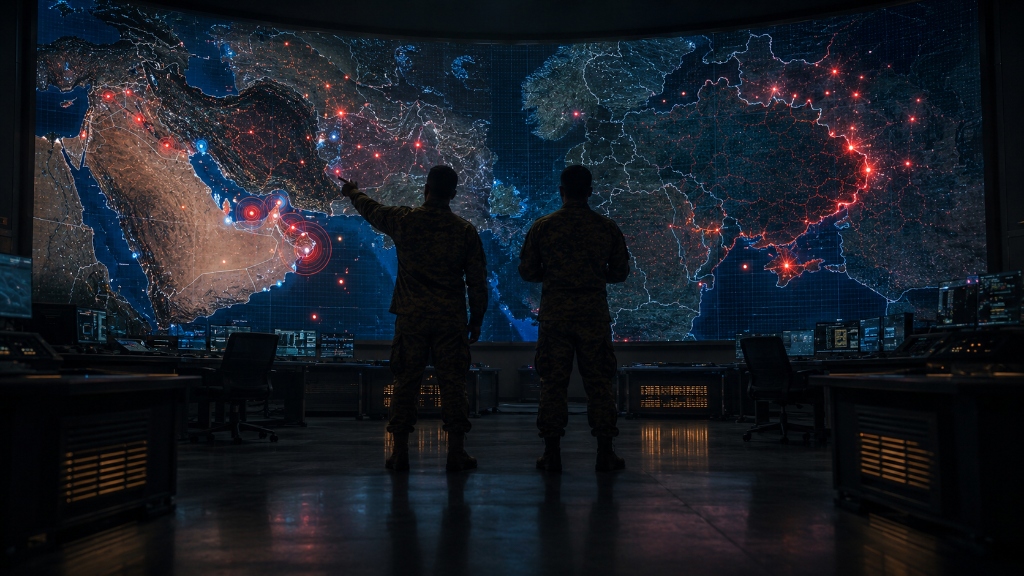
On April 18, 2026, over 150 merchant vessels were already moving. A fragile ceasefire had opened the Strait of Hormuz just 24 hours earlier, and the ships anchored in the Gulf of Oman, some for weeks, pointed their bows toward that narrow gap and started their engines. Tankers loaded with crude. Container ships. Gas carriers. Then the IRGC announced the Strait was closed again. Every vessel reversed course.
That image, 150 ships pointing nowhere in the Gulf of Oman, tells you more about the 2026 energy crisis than any oil price chart can.
20M
Barrels of oil passing through the Strait of Hormuz every single day in 2025, roughly 20 percent of global petroleum consumption
The Geometry of the Choke Point
The Strait of Hormuz is 21 miles wide at its narrowest point. Inside that width, there are two navigable shipping lanes, each two miles across. That is the physical corridor through which, in 2025, an average of 20 million barrels of oil moved every day, according to the U.S. Energy Information Administration. That figure represents roughly 25 percent of all seaborne oil trade worldwide.
The LNG dependency is equally severe. Qatar, the world's second-largest LNG exporter, ships 93 percent of its gas through the Strait. The UAE ships 96 percent. There is no pipeline alternative for either country.
| Country | LNG Exported Through Hormuz | Pipeline Bypass |
|---|
| Qatar | 93% | None |
| UAE | 96% | None |
| Saudi Arabia | Partial (crude) | East-West Petroline |
| Kuwait | ~100% | None |
| Iraq | ~100% | None |
Saudi Arabia does operate the East-West Petroline across the peninsula, which carries crude from its eastern fields to the Red Sea port of Yanbu, bypassing the Strait entirely. Its theoretical capacity sits around 5 million barrels per day. Roughly 2 million of that was already in use before the crisis. Even at absolute maximum, it covers perhaps a third of what the Strait normally moves. There is no other way around. The geography is the trap.
Oil Bypass Capacity vs. Hormuz Throughput
Maximum theoretical throughput by route — millions of barrels per day
How Iran Closed a Waterway Without Sinking a Ship
Iran did not need to sink a hundred ships to shut the Strait. The threat alone, backed by a credible area-denial architecture, did most of the work.
By early March, the IRGC had dispersed sea mines throughout the navigable lanes. Anti-ship cruise missile batteries sat along the Iranian coastline, positioned to cover the full choke point. Fast-attack naval units were conducting boarding operations against vessels attempting transit. The combination created what military planners call a layered interdiction matrix: to get through, you needed to survive the mines, survive the missiles, and survive the boats. Most commercial captains were not willing to find out which layer would stop them first. Contesting that blockade would go on to consume more Patriot interceptors than the Western alliance can build in two years.
The insurance market confirmed the calculation. On March 5, seven of the twelve major global marine insurance syndicates cancelled war-risk coverage across the Persian Gulf. Without that coverage, the world's major shipping conglomerates could not legally move their vessels into the theater. Their boards of directors would not permit it. The ships stopped before the IRGC had to stop them.
187
Total commercial transits through the Strait of Hormuz since March 4, against a pre-crisis monthly average of 4,140
Automatic Identification System data tracked by Starboard Maritime Intelligence tells the rest of the story in two numbers: before February 28, the Strait averaged 138 commercial transits per day. Since March 4, the total over roughly ten weeks stands at 187. Not 187 per day. 187 total. The vessels that do move largely go dark, disabling their AIS transponders, negotiating passage through IRGC-designated coastal routes deep inside Iranian territorial waters, and coordinating through intermediaries. Many pay informal transit fees. They are not transiting freely. They are transiting on Iranian terms.
Daily Commercial Transits — Before and After the Blockade
Average transits per day through the Strait of Hormuz
The Crisis Behind the Crisis: Fertilizer and Food
Energy headlines dominate coverage, and the scale of the supply shock is real. The IEA has classified the current disruption as the worst in oil market history, with a shortfall of 12 to 15 million barrels per day of crude and refined products. Brent crude sat above 110 dollars per barrel as of late April.
But there is a second crisis building on a longer timeline and harder to reverse. The Persian Gulf is not just where oil comes from. It is where a significant portion of the world's nitrogen fertilizer is manufactured and shipped.
Modern nitrogen fertilizers, specifically urea, are synthesized using the Haber-Bosch process: natural gas burned at high pressure in the presence of hydrogen to produce ammonia. The Gulf holds an enormous comparative advantage in this process because it has some of the cheapest natural gas on the planet. Qatar's QAFCO facility, the world's largest single urea exporter, sits inside the blockade.
"This supply rupture is establishing the baseline for a structural food security crisis in 2026 and 2027."
- Qu Dongyu, FAO Director-General
Between 20 and 30 percent of global fertilizers are currently stranded in the Gulf, according to UN Food and Agriculture Organization chief economist Maximo Torero. The reason the timeline matters: crops across the Global South operate on rigid nitrogen application schedules tied to planting seasons. Miss the application window and the yield collapses. You cannot retroactively fertilize a harvest.
Key Fact
The blockade is now damaging the country enforcing it. Iran's onshore crude storage at Kharg Island is approaching tank tops, with JPMorgan estimating capacity at 64 percent full. Once it fills completely, Tehran faces wellhead shut-ins, a physically destructive process that can permanently degrade reservoir pressure and future yield from mature oil fields.
Who Is Still Moving and Why
Of the 187 successful transits since March 4, over half are operated by companies in four countries. Chinese-flagged and Chinese-operated vessels make up the majority.
This is not coincidence. Beijing has leveraged its position as Tehran's largest oil buyer and most consequential economic partner to secure passage for its domestic supply chains. While Japanese, South Korean, and European tankers sit anchored in the Gulf of Oman, Chinese vessels are moving. The 2026 Hormuz closure has not just disrupted global energy. It has created a visible, tracked geopolitical bifurcation in who can access the world's most important oil corridor and who cannot. Every day this continues, that gap compounds.
| Operator | Transit Status | Reason |
|---|
| China | Moving | Beijing-Tehran bilateral agreement |
| Russia | Moving (limited) | Informal IRGC transit fees |
| Japan | Blocked | War-risk insurance cancelled |
| South Korea | Blocked | War-risk insurance cancelled |
| Europe | Blocked | War-risk insurance cancelled |
| USA | Blocked | Naval standoff, sanctions |
The OPEC Fracture
The UAE watched all of this from inside the Gulf, its own export operations disrupted by a war it had no part in starting. On April 28, Abu Dhabi announced it was leaving OPEC and the broader OPEC+ alliance, effective May 1. Fifty-nine years of membership, ended in a press release.
The decision had been building for years, driven by a fundamental tension: the UAE had invested heavily in upstream capacity, reaching around 4.8 million barrels per day, with plans to hit 5 million by 2027. OPEC quota constraints forced Abu Dhabi to keep much of that capacity idle, destroying the return on its sovereign infrastructure investment. The Hormuz crisis accelerated the timeline. Abu Dhabi intends to produce at full capacity and monetize its reserves before the global energy transition permanently erodes their value.
UAE Oil Production — Capacity vs. OPEC Constraint
Millions of barrels per day
Saudi Arabia and Iraq, the cartel's two largest remaining members, are now exposed to a producer that will add barrels to the market without asking anyone's permission. Riyadh's ability to set global oil macroeconomics just took a structural blow.
What the Silence Means
Pakistan and Qatar are leading the mediation effort in Tehran. The broad outlines of a deal are visible: the U.S. lifts its naval blockade on Iranian export ports, the IRGC guarantees commercial passage within 30 days, and a 60-day window opens to negotiate constraints on Iran's nuclear program. Tehran has demanded the release of 12 billion dollars in frozen assets as a precondition. A mechanism to route those funds through a Qatari intermediary to a Russian account was blocked by U.S. negotiators at the last stage. The talks are ongoing but fragile.
In the meantime, the 150 ships in the Gulf of Oman wait. The fertilizer stockpiles in Qatar stay unshipped. The IEA counts shortfall barrels by the million.
The Strait of Hormuz has been a theoretical vulnerability for decades. Every strategic assessment of global energy security has listed it as the single point of failure most capable of cascading into a systemic crisis. What 2026 has demonstrated is that the theoretical was always real, that a relatively small military force with mines, missiles, and fast boats could paralyze the flow of one-fifth of global oil consumption with no viable workaround available.
The world built its food and energy systems around a 21-mile corridor it could not defend and had no plan to replace. The ships in the Gulf of Oman are the consequence.